


The Losing Streak Ended, Friday - The Losing Baseball Persisted, Saturday
By John Nielsen
July 5, 2026
***
The Big Story
Friday night's 5-2 victory over the Minnesota Twins, which snapped a seven-game losing streak, proved to be nothing more than a brief respite.
The carnage returned to the Bronx on Saturday afternoon as Yankee pitching surrendered a season-high six home runs and New York's defense gifted Minnesota four more unearned runs in another sloppy, dispiriting performance. The Twins cruised to an 11-4 victory, dropping the Yankees to 49-39. New York has now lost eight of its last nine games and trails Tampa Bay by six games in the loss column.
The Twins wasted little time, scoring three runs in the first inning and adding two more in the second against Brendan Beck (0-1), who was making his major league starting debut on an emergency basis, replacing the freshly injured Carlos Rodón.
Beck earned his opportunity with three months of impressive work at Triple-A Scranton/Wilkes-Barre, posting a 7-2 record with a 3.07 ERA over 88.0 innings while striking out 91 batters. Saturday provided an immediate reminder of just how unforgiving the major leagues can be.
As the nation celebrated the 250th anniversary of American independence, the Twins spent the afternoon setting-off their own fireworks. Minnesota repeatedly punished Yankee pitching with loud contact, producing a barrage of missiles. The damage wasn't limited to Beck, as nearly every Yankee pitcher who took the mound found himself under siege. The sole exception was Brent Headrick. More on his misuse/abuse to follow.
Here's a look at Minnesota's hardest-hit balls on Saturday – just those with exit velocities exceeding 100 mph:
BATTER (Pitcher) | INNING | EXIT VELO | RESULT | NOTES |
Buxton (Beck) | 1st | 103.6 | Double | RBI |
Clemens (Beck) | 1st | 101.2 | HR (16) | RBI-2 |
Jackson (Beck) | 2nd | 105.7 | HR (1) | RBI |
Bell (Beck) | 3rd | 105.9 | Double |
|
Jackson (Beck) | 4th | 103.3 | Ground Out | 4-3 |
Larnach (Hill) | 4th | 105.8 | HR (6) | RBI-2 |
Lewis (Bird) | 5th | 102.7 | Single |
|
Bell (Yarbrough) | 7th | 107.6 | HR (12) | RBI |
This was anything but small ball. There were no bunts, swinging bunts, squibbs, Baltimore chops, dinks, dunks, doinks, flares, bloops, or seeing-eye singles. The Twins attacked only with authority, repeatedly ripping, crushing, lacing, smoking, scorching, drilling, barreling, and hammering baseballs all over Yankee Stadium.
The Yankees briefly threatened to climb back into the game during the middle innings. Jasson Domínguez launched his fourth home run of the season in the fourth inning to cut the deficit to 6-1. An inning later, Max Schuemann belted his second homer of the year, a two-run shot that trimmed the margin to 6-3. Later in the fifth, after Trent Grisham and Ben Rice drew walks, Cody Bellinger crushed a drive that initially looked destined for the seats in right-center. Instead of tying the game, it stayed in the park for an RBI double, pulling New York within 6-4.
The Yankees' best chance to complete the comeback came in the sixth. With one out, they loaded the bases against Twins reliever Travis Adams, prompting Aaron Boone to pinch-hit for light-hitting catcher Ali Sánchez, who had grounded into a double play earlier in the afternoon.
Boone's options weren't especially enticing. He could turn to right-handed hitters Amed Rosario, José Caballero, or Paul Goldschmidt, who entered the game mired in an 0-for-20 slump, or left-handed-hitting Austin Wells, whose batting average had fallen to .150. Boone chose Rosario, who looked badly overmatched, striking out on four pitches.
Minnesota manager Derek Shelton immediately countered by summoning left-handed side-armer Taylor Rogers to face Trent Grisham. Boone responded with Goldschmidt, who battled through the at-bat before lifting a routine fly ball to left field, ending the threat and, for all practical purposes, the Yankees' comeback hopes. Rogers (4-3) was credited with the victory after recording the pivotal out, and deservedly so.
Any remaining suspense disappeared in the seventh when Ryan Yarbrough surrendered a leadoff home run to Josh Bell, extending Minnesota's lead to 7-4. The Twins then blew the game open in the eighth. A fielding error by Jazz Chisholm Jr. opened the door to four unearned runs, two of which scored on Bell’s second home run of the afternoon.
Friday night's victory briefly eased the symptoms. Saturday's loss reaffirmed the diagnosis.
The seven-game losing streak was never the disease; it was merely the most visible symptom of a club with deep, systemic problems. Those issues now touch nearly every facet of the game: inconsistent starting pitching, an increasingly unreliable bullpen, defense that too often resembles that of an amateur youth league, and an offense that struggles not only to score runs but even to generate hits. Layer on a growing list of injuries, a lack of major league-ready reinforcements in the farm system, and questionable in-game management by Aaron Boone, and it's easy to see why the Yankees continue to spiral.
Until those underlying deficiencies are addressed, directly, the Yankees will keep losing more games than they win.
Bellinger’s Travails, Wells’ Struggles & Volpe’s Latest Slump
Bellinger's RBI double was his first extra-base hit since June 24 and his first RBI since June 17—a drought of 18 days and 15 games. Over a full 162-game season, that pace would produce roughly 11 RBIs. During that stretch, Bellinger scored just one run while going 5-for-49 with a .357 OPS.
Austin Wells has been even less productive. Over the same span, he's just 2-for-27 with a staggering .185 OPS. Yes, you read that correctly: .185.
Anthony Volpe hasn't fared much better. Since June 24, he's gone 3-for-25 with a .345 OPS.
At the moment, all three hitters the Yankees have counted on so heavily look completely lost at the plate. They've become, for all practical purposes, automatic outs.
Under MLB rules, the veteran Bellinger cannot be optioned to the minors. Wells and Volpe enjoy no such protection. Based on their recent performance, both deserve a return to Triple-A. Their demotions cannot happen soon enough. Maybe it would send a message?
Boone’s Pinch-Hitting Decision Defensible – Not Use of Headrick!
Michael Kay was highly critical of Aaron Boone's pinch-hitting decisions during Saturday's YES broadcast, but with the game on the line, those moves were entirely defensible.
Once Boone decided to hit for Ali Sánchez, Rosario was the logical choice. He had been swinging a hot bat all week, and there wasn't a better right-handed option available off the bench. After Minnesota countered with Taylor Rogers to face Trent Grisham—who entered the day 0-for-2 (both strikeouts) lifetime against the veteran left-hander—Boone's decision to turn to Goldschmidt also made sense. Goldschmidt, despite carrying an 0-for-20 skid into the at-bat, has been elite against left-handed pitching over his two seasons in the Bronx. Saturday afternoon it didn't work. That's baseball, Suzyn.
Boone's bullpen management, however, is another matter entirely.
Using one of his few dependable high-leverage relievers, Brent Headrick, to pitch the ninth inning while trailing 11-4 is impossible to justify. Why not simply send the ineffective Camilo Doval back out to absorb another inning? Worst case, had the deficit grown to eight runs, Caballero could have finished the game under the position-player rule.
Instead, Boone asked Headrick to shoulder the inning, lengthened by five additional pitches due to Ryan McMahon's sloppy, unforced throwing error. The Yankees not only failed to protect one of their most reliable bullpen arms, but they also potentially compromised his availability for Sunday's game, as well.
In a stretch where every winnable game matters and quality relief pitching is already in short supply, that decision was managerial malpractice.
Where’s the Anger?
My greatest frustration with the 2026 Yankees isn't the recent losing—it's the complete lack of urgency.
I understand baseball is a 162-game marathon, not a sprint. Teams go through slumps, and overreacting to every loss is a recipe for disaster. But what we're watching now feels less like a team battling through a fever of adversity and more like one that's become completely numb to it. And this is not the first time this has happened – it’s four or five seasons in succession!
Baseball history is filled with managers who find ways to shock their clubs and resuscitate them back to life. Billy Martin could ignite a team with a fiery on-field argument, kicking dirt on an umpire or covering home plate, securing an intentional ejection. Jim Leyland and, on occasion, Joe Torre were known for delivering blistering clubhouse speeches that challenged individual players to man-up and play better. Lou Piniella? He'd flip over tables, pick up and toss a base like a discus thrower, smash a water cooler with a bat, heave an assortment of equipment on the field or gin up an altercation with an umpire—anything to send the message to his players, coaches, executive management, ownership, the media and the paying public that losing was simply unacceptable.
Whether those theatrics changed the standings is open to debate. What they unquestionably communicated was that the manager cared deeply, that winning and competency mattered, and that complacency would never be tolerated.
Aaron Boone projects none of that urgency and it’s perfectly reflected by his players between the lines. For weeks on end, the Yankees play uninspired, sloppy baseball, and night after night Boone delivers another measured postgame explanation before rolling the same group back onto the field the next day, as if the past is forgotten and irrelevant. There is no anger, no accountability, and no indication that the status quo is unacceptable.
Brian Cashman is no different. It’s now evident that he and Boone are an indivisible pair. That reality notwithstanding, as Senior Vice President/General Manager, doesn’t Cash have his own role when the club is so obviously in free fall? Where is the demotion that sends a message to the entire organization? Where is the trade that shakes up a roster? Where is the firing of a manager who has so thoroughly earned it? Crickets from Cashman. And so far, from ownership. Until Hal has had enough, the disease will only continue to metastasize.
For a team with championship expectations, this is the most troubling warning sign of all. This is the cancer that must be treated!
Boone/Cashman/Steinbrenner seem content to roll it back night after night, heading home with their collective tails between their legs. We’ll get ‘em tomorrow. We’ll get ‘em next year. Just stay competitive. That’s good enough.
Aren’t you sick of it?!
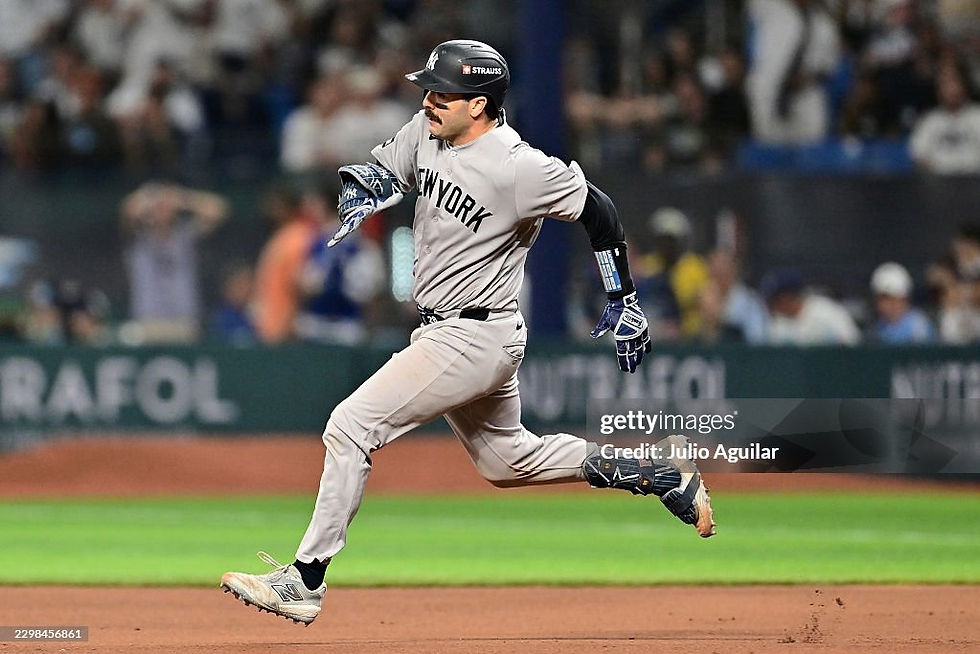


Where’s the Anger?
My greatest frustration with the 2026 Yankees isn't the recent losing—it's the complete lack of urgency.
~~~~~~~~~~~``
this is a good, good point, a central concern.
if the organization and the team does not understand the peril of the moment there is something very deficient in their understanding of the mission.
it is one thing to present a public face filled with quiet confidence and self-assuredness, the team is, after all, faring decently even though currently well out of the tall grass and possibly headed into the weeds.
still well over .500, still regarded as the best time in the AL, it might be regarded as evidencing a lack of grace under pressure to look wide-eyed and…
Finally, someone other than me is pointing the finger at other than Boone.
If it was up to me, both Volpe & Doval would be told to pack their bags and head to Buffalo (where SWB is playing next week). As for Wells? I'm not convinced he is healthy. I'd go and ask him; are you really healthy? If he says yes, I'd say, OK then, off to Buffalo with your buddy Volpe. Also, with baseball being such a superstitious sport, I'd ask Wells to look at something - he grew his beard, but since then has stopped hitting. Concidence?
All winter i said tha the Yankees need to replace those automatic outs in the lineup, specifically ss, 3B, an C. They did nothing..