


Yankees Bang for the Buck 2026 Report and More!
Yankees Bang for the Buck 2026 Report and More!
…Thoughts from Cary Greene
November 5, 2026
***
Every offseason I do a Bang for the Buck report that breaks down each Yankees true on-field-performance based on what each player was paid. If I were a MLB GM, this information would be a key to shaping my roster for the coming season.
Here’s the positional Bang for the Buck report for this past season’s Yankees.

The Yankees received most of their Bang for the Buck from Ben Rice and his supporting cast of Jazz Chisholm, Austin Wells, Paul Goldschmidt, Jose Caballero, Anthony Volpe and Spencer Jones. Luis Garcia was a productive player as well, but the chart above doesn’t prorate a player’s time with the Yankees only but rather, it looks at each player’s entire season, regardless of which team(s) the player played for.
One would think it would be nearly impossible to offset the lost payroll that was sunk into Giancarlo Stanton, Aaron Judge, Ryan McMahon and others, but thanks to all of the other contributions that players made up and down the rest of the roster, somehow the Yankees came out ahead positionally. In this regard, the Yankees season was a bit of a miracle. Imagine what would have happened if Wells had continued slumping, or if Rice had cooled off dramatically, or if Jones and Lombard hadn’t adjusted to MLB pitching so positively. Also, what if Goldschmidt had just fizzled out to start the season? He was also a key piece to the success of the 2026 Yankees.
The Yankees most polarizing positional player was Jazz Chisholm, but based on his on field performance compared to what he was paid, he provided a lot of value to the Yankees this past season.
After recently being extended by Hal Steinbrenner, Yankees GM Brian Cashman will embark upon his 30th season with the team. His first order of business was to vet out which Yankees from this past season’s team who are now free agents should receive qualifying offers and which ones shouldn’t. There were really only two decisions to be made - involving whether or not Jazz Chisholm or David Bednar should receive QO’s.
In the case of Chisholm, he was worth a lot more on the field than many Yankees fans would probably believe. However, considering that the MLB QO this offseason is $23.15 million and Chisholm’s play on the field was only worth $17.5 million, it would have been a very bad business decision to give him a QO.
In order to evaluate whether or not extending the qualifying offer to Bednar was a good decision, here’s a look at the Yankees 2026 Pitching Bang for the Buck report:
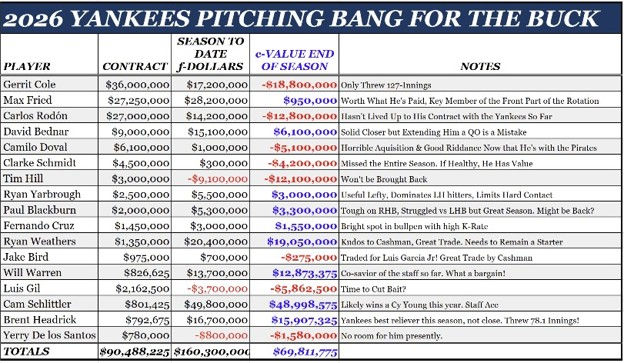
On the surface, it looks like extending a QO to Bednar is not a good business decision. However, he happens to be an elite closer and elite closers are in very high demand throughout MLB. Established mid to upper tier late-inning veteran pitchers earned between $11 million to $14 million this past season. Elite closers however, earned between $16 million and $23 million. Based on Bednar’s performance this season, he will likely fall into the elite closer pay scale range, which will no doubt be incrementally higher next season than it was this season.
Also, it’s very hard to find elite closers on the open market, due to how in demand they have become in MLB. Therefore, a one-year QO for $23.15 million for Bednar, a closer who relishes the immense mental challenge of pitching high leverage, end of game innings in New York, is a solid front office baseball decision.
It should come as no surprise that the Yankees got an astronomical bang for the buck from staff ace Cam Schlittler. Our own Any Singer was the high man on Schlittler long before he appeared on the scene. Boy, did he call that one. Schlittler was worth an astounding c-Value of $48.9 million this season. Two other Yankees pitchers provided extremely high c-Values, Ryan Weathers ($19 mil) and Brent Headrick, ($15.9 mil). This spring, I wrote that of all the Yankees bullpen options other than Bednar, I thought Headrick looked like the one who was capable of creating the most uncomfortable bats. Looks like I was right on Headrick, as he was one of the top set up men in MLB this season and the beauty of it all is this – the Yankees will enjoy four more years of team control on Headrick, so he’ll be around for several more seasons.
Drawing the conclusion that Brian Cashman did an outstanding job sculpting the Yankees pitching staff this season is an understatement. Despite both Cole and Rodon being injured to start the season, Cashman still achieved fantastic results, his Yankees pitching staff provided more than double the c-Value than his positional players provided. The Yankees enjoyed a windfall of $68.9 million in total c-Value from their pitching staff this season. Of course, having Cam Schlittler, Ryan Weathers, Brent Headrick and David Bednar around certainly didn’t hurt.
With the Yankees beginning to prepare for the Rule 5 Draft, Yankees GM Brian Cashman will be making a few under the radar moves to protect prospects and possibly make some trades involving players he chooses not to protect. At the time of this writing, November 3rd, 2026, the Yankees have seven 40-man roster vacancies a little over a month before the Rule 5 Draft is scheduled to commence.
The Rule 5 Draft is currently expected to take place during the 2026 MLB Winter Meetings in December, though baseball analysts note that an uncertain offseason landscape exists without an agreed upon collective bargaining agreement in place. Mid-November is usually the deadline for teams to finalize their 40-man rosters and in doing so they’ll both prevent exposed prospects from being selected by other organizations at the Winter Meetings, while also inevitably exposing prospects who will be therefore determined eligible for the Rule5 Draft.
Today, the Yankees quietly protected Marco Luciano, by promoting him to their 40-man roster. Luciano posted a .933 OPS across two levels this season (Double-A and Triple-A), belting 27 home runs and driving in 78 runs. He’s still striking out one out of every four at-bats, but the contact he’s making is loud and the power he’s showing is real.
Coincidentally, both of my friends who are MLB scouts had identified Luciano as a player to inquire about this offseason, ahead of the Rule 5 Draft. Cashman has certainly sent a message for all of the professional roster picking scout vultures to see. If a team wants Luciano, they have to pony up some prospect value as there will be no snagging him for virtually nothing if they wait until the Rule 5 Draft.
Notwithstanding a trade, Luciano is now in position to battle for a spot on the Yankees roster this spring. He’s capable of playing second base, shortstop, third base and left field. Given his defensive skill set and his potent bat, the Yankees would be wise not to trade Luciano, as he may wind up making the team out of training camp. We shall see. Keep an eye on Luciano.
Glancing over the pool of currently unprotected Yankees prospects, who have not yet cracked the 40-man roster, there are no less than 20 unprotected players between the Rookie Developmental, Low-A and High-A levels of the Yankees system and there are another 34 unprotected players in the higher levels of the Yankees system, including Double-A and Triple-A. Cashman’s main pre-Rule 5 Draft goal will be to create enough space on the Yankees 40-man roster to protect the prospects deemed worthy of a roster spot.
Out of the 54 prospects I’m projecting will be Rule-5 Draft eligible if they are not added to the Yankees 40-man roster, 18 of them were signed by the Yankees as International Amateurs and that’s a very high number. What’s even more concerning is that 13 of them are spread between the Rookie (3), Low-A (3) and High-A (7) levels of the Yankees system. All of them will have exceeded service time and will be Rule-5 eligible.
After the season ends, the Yankees will have a smidge over $202.8 million on the books for 2027. Remaining under contract on the positional side of things will be Aaron Judge; Cody Bellinger; Giancarlo Stanton and Ryan McMahon. Pitchers Gerrit Cole; Max Fried and Carlos Rodon are also under contract. Nine other Yankees players will be in various stages of arbitration eligibility: Luis Garcia Jr; Clarke Schmidt; Fernando Cruz, Ryan Weathers, Anthony Volpe; Luis Gil, Jose Caballero; Austin Wells and Heliot Ramos.
Other players currently occupying 40-man roster spots are: Brendan Beck; Kevin Castro (IL-60); Yerry De los Santos; Luis Gil; Bradley Hanner; Elmer Rodriguez; Max Schuemann and Clarke Schmidt (IL-15).
Players on thin ice with the Yankees organization right now are Giancarlo Stanton, Ryan McMahon, Anthony Volpe, Heliot Ramos, J.C. Escarra, Ali Sanchez, Luis Gil, Clarke Schmidt, Yerry De los Santos, Angel Chivilli and Kevin Castro. Barring a surprise decision by Cashman to release any of these players, we can project these players to occupy spots on the Yankees 40 man roster.
There are also no less than 10 free agents who dropped off the roster as well: Trent Grisham; Paul Goldschmidt; Tim Hill; Ryan Yarbrough; Amed Rosario; Paul Blackburn; Michael Fulmer; Jazz Chisholm, David Bednar and John Schreiber.
It appears that the Yankees will have some room to maneuver prior to the Rule-5 Draft taking place - assuming it does take place that is. It’s hard to project how many spots the Yankees will be able to create on their 40-man roster, but currently there are seven openings.
There’s no doubt that a few of the soon-to-be free-agents are players the Yankees might like to bring back, but that won’t happen until well after the Rule-5 Draft and remember, with each signing, a corresponding roster decision must be made in order to create room. Paul Blackburn and David Bednar appear to be two that Cashman may attempt to sign. Beyond those two, I don’t think that any of the other pending free agents will be brought back - including Jazz Chisholm.
I’ve poured over the list of all 55 Rule-5 Draft eligible players in the Yankees system and there are some names that do jump out, like Carlos Lagrange; Kyle Carr; Eric Rayzelman; Roderick Arias; Garrett Martin, Cade Smith; Brock Selvidge; Jace Avina; Harrison Cohen, Trent Sellers and Coby Morales among numerous others. The Yankees will absolutely protect Lagrange and probably Arias as well and they’ll have plenty of room to protect a decent tranche of others they deem worthy.
We’re hearing rumblings that the Yankees will be looking for cost effective ways to fill in their roster and this should come as no surprise, given the looming lockout and the uncertainty regarding payrolls, what the implications of a potential salary cap would entail and even, whether or not there will be a lockout that threatens a piece of - or possibly - the entire 2027 season.
For now it looks like Hal Steinbrenner won’t be making any moves that cost significant sums of money and this may impact the team’s pursuit of international star Teruaki Sato, who has numerous suitors besides the Yankees, such as the Phillies, Dodgers, Mets and Red Sox. Sato presently has a posting window of a little less than a month, so if a team wants him, they’d best get aggressive immediately.
In winding down today’s conversation - and I don’t view this as an article but rather, the start of a conversation in the comments section - there’s a notion I’d like to agree with and one I’d like to clarify. It’s been said here on SSTN and elsewhere that the Yankees play a sloppy brand of baseball. Some even contend that almost all MLB teams play sloppy baseball, save for this year’s cream of the crop, the four teams that played in their respective League Championship Series.
First, let’s admit that the Yankees weren’t a very good defensive team this past season. I like Fangraph’s Def stat and if we use that, the Yankees were very average, they ranked 15th out of 30 MLB teams. In terms of Def, the really good defensive teams this season, in order, were the Cubs, Blue Jays, Padres Diamondbacks and Cardinals. If you favor OAA, the Yankees were even worse, they ranked 17th. The teams with the best OAA (Outs Above Average) were the Cubs, Diamondbacks, Cardinals and Braves. Or, perhaps you like DRS (Defensive Runs Saved) as your favorite defensive metric, in which case the Yankees ranked 13th - with the best team being, surprise, surprise, the Cubs, followed by Rays, Red Sox, Braves and Brewers.
Defense wins championships in baseball, but it's largely because of good pitching, not glove work. This is not to throw shade at Brooks Robinson or Graig Nettles, because their contributions to their respective teams that won championships were immensely important in the clutch. This year’s four Championship Series participants all played, no matter what metric we use, significantly better defense than the Yankees did. However, they were not among the League’s top defensive teams in most metrics.
Why did the Yankees get eliminated from the postseason, yet again, this year? Well, the Yankees didn’t lose in the postseason this year because they played horrendous defense. They lost because they didn’t score runs. They lost because they didn’t hit well with runners in scoring position - the all important RISP.
Also, the Brewers beat the Rays because they hit way better with RISP than the Rays did. Baseball is a simple sport. It’s about driving in base runners who are in scoring position and then not letting your opponent do that. Baseball isn’t about walks and home runs - though this is certainly a part of playing winning baseball.
Winning teams advance runners from first base to second base. Why do they do this? Well, they do it because it’s far more likely that they can score a runner from second base than they can if the runner is only on first base. There are only three outs in an inning. If team A gets a runner on first base and tries to drive him in with home runs - sometimes they do succeed, but more often, they fail. However, if team B gets a runner on first base and they are able to advance him into scoring position - either second or third base, they drive the runner in via a variety of methods, from base hits to sacrifices.
In the postseason, when pitching is elite, the team that can 1. Get runners into scoring position and 2. Plate said runners – has a distinct advantage over the team that is relying on getting a runner on base (often by a walk) and then waiting for a home run.
If you do the research, you will find no correlation whatsoever between playing three outcome baseball and winning championships. That’s because one doesn’t exist. When the Yankees dispatched the Red Sox in short order this season, they did so in a multitude of ways. Ultimately, the Yankees hit better with RISP than the Red Sox did.
However, the deeper the Yankees seem to get into the playoffs, they can’t sustain a multidimensional attack. They get exposed by elite pitching. Walks are hard to come by and home runs are few and far between.
It appears Brian Cashman and his Yankees analytics officers do not agree with this notion I’ve been a proponent of ever since I became a fan of the game of baseball, some 55 years ago! I haven’t invented anything new here in this piece today folks - other than c-Value (which I came up with two years ago). Baseball is a simple sport afterall.
I’ll remind everyone reading this that making a plan for this year’s Yankees offseason was very simple for me to do. In fact, any of us could make a plan, but would Hal Steinbrenner spend to make it happen? I’m not so sure. The Yankees came up short this year, again! They couldn’t hit with RISP when it mattered and they couldn’t stop the other team from hitting with RISP when it mattered.
If the goal is to improve the roster in key areas, the answer is right there for all to see. The Yankees need to build a roster that can hit with RISP and they have to be even better at stopping other teams from doing this. The middle of the Yankees lineup, their #3, #4, #5, and #6 hitters batted .071 with RISP in the Division Series.
If the heart of the lineup needs increased production that could be achieved by bringing a few players into the organization that have demonstrated, recent track records of not only driving in runs, but showing a strong ability to hit with RISP, then that is what Hal Steinbrenner should want Brain Cashman to accomplish.
I’m already on record as advocating for the Yankees to sign Teruaki Sato and Randy Arozarena. The team needs a third baseman and probably a right fielder/DH. These two players change the heart of the Yankees lineup. Would two different players be able to achieve a similar result? I wasn’t able to identify two that would be such clear offensive upgrades.
The Yankees should also trade for Steven Kwan and that means giving Spencer Jones some time in Scranton to shorten his swing and learn to get to elevated pitches in the zone. He was exposed by the Rays this postseason. Kwan would give the Yankees an actual leadoff hitter, something they desperately need. Kwan’s .382 OBP combines with his ability to hit with runners in scoring position and it makes him an ideal leadoff hitter for 2027. Also, he’s a better center fielder than Spencer Jones is right now and it isn’t close.
Granted, I’m running on the presumption that the Yankees will release Giancarlo Stanton and yes, I do understand that Hal Steinbrenner hates to pay double, but this needs to be done unfortunately. It’s time. It will be up to Brain Cashman to understand this and make the case. If he doesn’t do this, it will be a massive failure on his part.
I’d be curious to learn if any of our readers have identified a better plan to fix the Yankees lackluster ability to hit with RISP - the team was 19th in MLB with a .246 average with RISP this season. If Brain Cashman is aware of this, he should be going all out for Sato (.317 with RISP), Arozarena (.337 with RISP) and Kwan (.324 with RISP).
To those that want Seiya Suzuki (.213 with RISP) over Arozarena, I counter with a simple comment - he doesn’t fix what’s wrong with the Yankees.




I think only Ramos or Dominguez will be on the roster next year
With only about 33 players currently on the 40, a lot of these at-risk players are safe.
The Yankees sign these IFA kids and then sit them in rookie ball for years. I can only think of about 5 guys who didn't sit 2+ years since I've been actively tracking this since about 2007. That's why there's always a whole bunch of them that are Rule 5 eligible.
Surprised, but not surprised that they put Luciano back on the 40. He mostly played 2B this past year too. But I only have about 8 serious contenders to be added to the 40 man roster in the next…
It looks like the numbers for the partial-year players are for full-year salaries. I'm guessing there's not an easy way of extracting the Yankee-only portion both of salary and value?
what about those of us who want a right-handed hitter capable of playing center field rather than Arozarena?
if the Yankees needed a DH, Arozarena would be a fine candidate, but they already have a good lefty DH in Ben Rice and a right-handed DH candidate who is a more valuable hitter than Randy in Judge.